


A sermon preached by Fr. Cody Maynus at All Saints Church, Northfield, Minnesota on April 5th, 2026, the Day of the Resurrection.
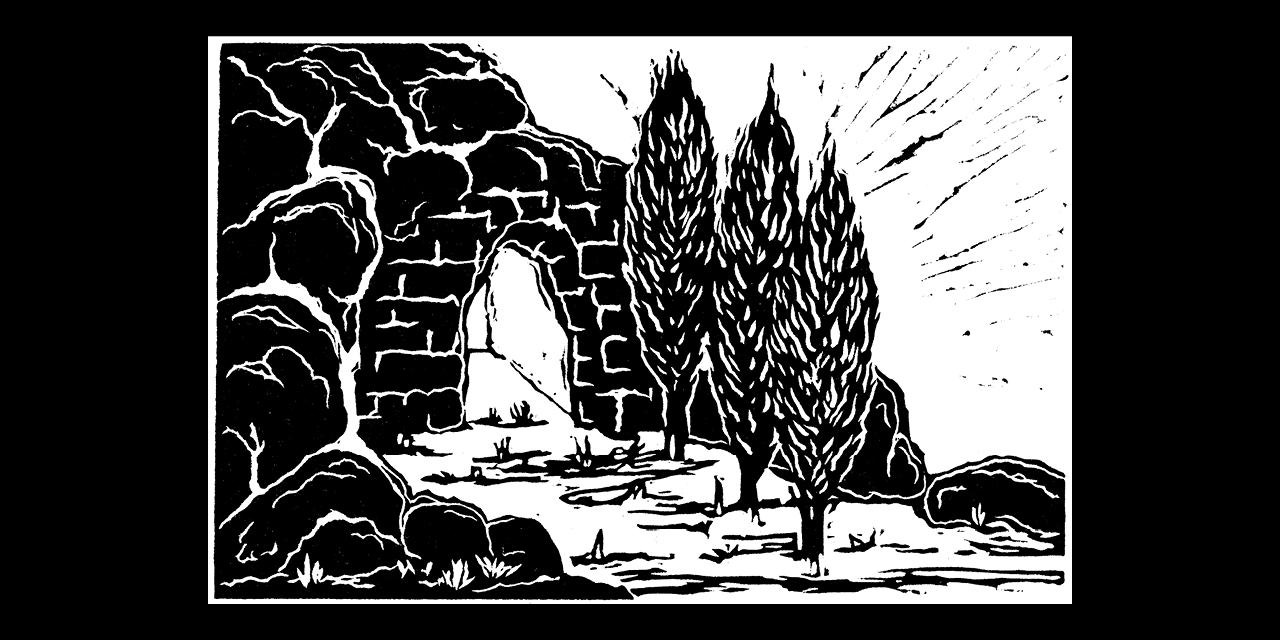
“New life starts in the dark,” writes the Rev. Barbara Brown Taylor.
“Whether it is a seed in the ground, a baby in the womb, or Jesus in the tomb,
it starts in the dark.”
It’s really unclear why Mary Magdalene goes to the tomb that morning.
The broken body of her lord and teacher and friend
has been prepared for burial:
Mary and the others have lovingly washed and anointed Jesus’s body with spices
and placed him in Joseph of Arimathea’s unused tomb.
Pilate’s soldiers have rolled a huge stone in front of the tomb,
sealing Jesus’s lifeless body inside the cave.
There was no rational reason for Mary to leave her bed
and make her way through the streets of the city
and out to the garden where Jesus had been buried.
There was no rational reason for it,
but, as I think we all know, grief is rarely rational.
Mary arrives in the darkness and finds that the stone has been rolled away.
Even though she has been Jesus’s faithful follower and friend,
her first instinct is not that he has been resurrected as he promised,
but that the soldiers or the religious leaders have taken him away.
Her first experience with the resurrected Christ is not faith, but loss.
The trauma of her teacher’s body being removed
compounding the trauma of her teacher being killed in the first place.
Mary runs back to wherever it was that Jesus’s disciples were staying
and she wakes Peter and John,
Jesus’s closest followers and friends,
the one upon whom Jesus built his Church
and the other to whom he entrusted his Mother.
Mary wakes Peter and John and they all three sprint toward the tomb.
John arrives first
—as the writer of John’s gospel is quick to point out—
but he doesn’t enter the tomb.
He hesitates at the threshold,
perhaps overwhelmed or frightened or simply confused.
And Peter, well, Peter does what Peter does best:
he barrels in,
like a bull in a porcelain cabinet,
and stares in disbelief at the strips of cloth laying in a heap on the ground,
strips of cloth which he and the others had so carefully draped and wrapped.
John finally screws up the courage to enter into the tomb
and takes in the full scene as well:
the ledge where the body of their teacher and friend
had, just a few days ago, by lying limp and lifeless.
The Gospel says that John believed,
but it’s unclear what he believed.
As you can imagine, there is not actually a ton of precedence
for dead bodies getting up and walking out of their own tombs.
Peter and John come in the dark and the leave in the dark,
perhaps to rouse the other disciples,
perhaps to ask their learned friend Nicodemus what’s going on,
perhaps simply out of fear and trembling.
But Mary…stays.
She pushes past her fear and hesitantly enters the tomb.
She sees the same things that the boys saw:
the empty ledge,
the crumpled linen shroud,
the full and unwieldy weight of absence.
But she also sees something else,
something that John and Peter either missed or perhaps weren’t privy to:
three being in dazzling white,
two seated on the ledge
and the other standing in the doorway.
She figures that this one dwelling at the threshold must be the gardener
she pleads with him to return the body.
Lovingly, tenderly, this gardener calls out her name
and only then does Mary realize that she has encountered not a gardener,
but her dearest friend,
no longer dead, but alive.
Not merely alive, but positively bursting forth with life.
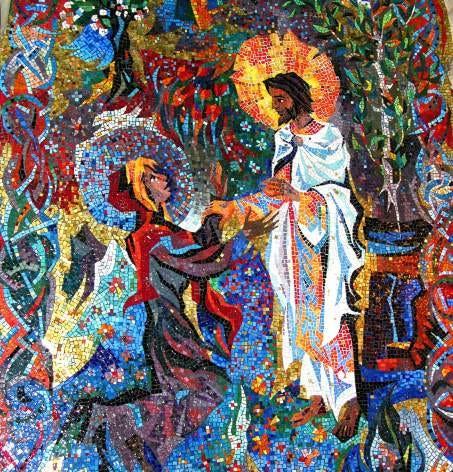
In that moment—in that encounter—everything changes.
Not because Mary all of a sudden understood the metaphysics of resurrection.
Not because she had made a verbal confession of a creed
or assented intellectually to a particular doctrine.
But because she had been seen, known, called by name.
The late Pope Francis cited his predecessor in saying
“Being a Christian is not the result of an ethical choice or a lofty idea,
but the encounter with an event, a person,
which gives life a new horizon and a decisive direction.”
The trouble this morning is, of course, that none of us were there in the Garden.
We were not standing next to Mary that morning.
We did not hear our names spoken aloud
from the recently dead and yet somehow now alive again
mouth of our teacher and friend.
We inherit this story through the distance of millenia
and are asked to somehow make sense of it.
And maybe that’s why every year, right around Easter,
there are all kinds of essays and interviews online
and in the newspaper
quietly or even loudly admitting a lack of belief in the Resurrection of Jesus.
It’s jarring—and, I suspect, lucrative for the media—
to hear respected theologians
and seminary presidents
and parish pastors
admit that they don’t think Mary’s encounter with Jesus could have happened.
After all they say, it is hard to believe that the dead do not stay dead.
Maybe you’ve felt that way too.
Maybe you feel that way currently.
Maybe you came here this morning with hope…but also hesitation,
with longing…but also doubt.
It’s true, of course, that the world in which we live
does not make resurrection easy to believe.
The world in which we live is one where violence continues to happen,
where traumas pile up and cause grief to linger,
where families are torn apart and communities are stretched to breaking points,
where division and despair and desolation are daily occurrences.
Mary knows that world.
Mary lives in that world.
And still—she stays.
And it is precisely in that world
—surrounded by doubt and despair and desolation,
confusion and uncertainty and fear —
it’s right in the midst of all of it that Mary hears her name,
not in an idealized place of perfect serenity and bliss,
but in the midst of the funk of life.
New life does not begin in certainty.
It begins with someone who cannot yet believe, but who refuses to walk away.
Someone who is honest about death, but open
—just barely—
to being surprised.
And that’s enough. That’s enough.
Because that’s where Jesus meets us,
week in and week out,
day after day after day.
Not only in ancient gardens,
but right here,
in this place,
at this table.
We are given the opportunity for encounter every time we approach the altar
and kneel or stand at the Communion rail.
We do not need to reconstruct the empty tomb
or reason our way past lingering doubt,
or achieve some sense of final certainty.
All we have to do is show up.
To bring all of ourselves
—our grief and confusion and fear and apprehension and doubt and despair—
and receive the Body and Blood, Soul and Divinity
of our risen Lord, teacher, and friend.
The conviction of the Church
—the hope of Easter—
is that Christ is really and truly present here:
not as an idea,
not as a memory,
but as a living presence
—a living Person—
who meets us again and again
in the breaking of bread.
So come.
Come as Mary the Apostle to the Apostles and Peter the Rock and John the Beloved.
Come as saints have come for centuries.
Come as your parents and their parents came.
Come as your children, God willing, will come.
If you come this morning full of faith, come.
If you come this morning, full of doubt, come.
If you come clinging to hope by the thinnest of threads, come.
Come and hear your name.
Come and dine at the supper of the Lamb.
Come and receive what you cannot prove.
Come and receive the life that does not stay buried.
Come and taste the joy that death cannot hold.
Come and be sent again in the world
to tell the world that you, too, have seen the Lord.
Amen.
Beautiful and brilliant.
“New life does not begin in certainty.
It begins with someone who cannot yet believe, but who refuses to walk away.
Someone who is honest about death, but open
—just barely—
to being surprised.
And that’s enough.”
This morning I was fixated on Jesus calling Mary’s name. She realizes it’s him by hearing him say her name - recognizes its clarity, its tenderness, its call. How fully and lovingly she is seen by her teacher.
Thank you for this 🤍
(I will also always laugh at the “which BTW John won the foot race if anyone’s keeping score” line. Classic.)